Tuesday, June 29, 2010

Technology Populism


Technology Populism — information workers provisioning technology outside of IT's auspices — is a topic of great interest to both technology vendors and IT departments. But is it more hype than reality? No. Information
workers are increasingly playing a role in selecting and managing the smartphones, computers, and software they use to get their jobs done. And because IT departments feel the necessity of meeting the growing needs of a distributed workforce while cutting costs, we see them increasingly allowing some technology autonomy for workers. For technology product marketers, this means speaking directly to end users about solving their specific business problems. Going forward, technology vendors will have to design, develop, and market products directly to a variety of information workers who, like consumers, have myriad choices

Technology populism is driven by people's need to interact. For many employees, the telephone and e-mail are being replaced by text messaging, instant messaging and mobile devices such as iPhones and Blackberrys, and social computing tools such as Facebook and Wikipedia. Drivers behind technology populism include: (1) Cheap broadband at home and work as personal and professional lives converge (2) A new generation of applications based on network interactions

To compete among the niche group, IT managers to be driven by ‘technology populism'

Friday, June 18, 2010

No(n parameter) constructor in Value Type


There are two key types in .NET framework (1) Value (2) Reference. As we know, value consumes stack and reference uses heap memory to store direct and indirect data. On working in Value type .NET objects, got the quite
interesting observation.

In terms of constructor, there are two significant differences between value and reference types.
1. Value type can't define non-parameter constructor where as reference will.
2. If no constructor is defined, .NET Compiler can produce default non-parameter constructor for reference type, where as value type can't.

1. Non parameter
On writing the below code with parameterless constructor, .NET compiler throws the error 'Structs cannot contain explicit parameterless constructors'
public struct RectangleInfo {
public RectangleInfo() {

2. No constructor
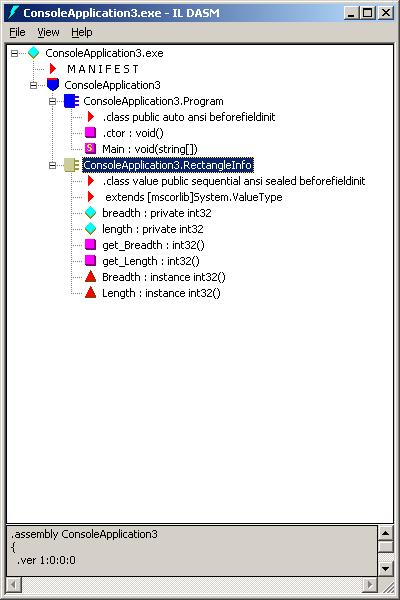
On using ILDASM to inspect the members of the value type, a parameterless constructor is not a member of the structure as marked in the attached image. But during the app execution, .NET framework has ability to instantiate a value type by using a language's constructor called implicit default constructor.

Sunday, June 13, 2010

Recommendation Note


This week is in vacation mode at Goa beach resort;completely out of work station. Got a surprise recommendation note from Dave, one of the popular web master.

Last year, published an article in code project (http://www.codeproject.com/KB/silverlight/DB_in_SL3.aspx). CRUD explains the complete operation in any language; itz about Silverlight 3. Dave recommended it(http://www.daveenjoys.com/2010/05/20/introduction-to-web-net-programming/) with code example category. In general, motivation drives additional energy and so i'm ready to publish next CRUD article in ASP.NET MVC Framework.

“Truth, naked, unblushing truth, the first virtue of all serious history, must be the sole recommendation of this personal narrative.”-Edward Gibbon(1780). Thanx Dave!

Saturday, June 5, 2010

HTML5 beats


HTML5 beats Adobe Flex, Microsoft Silverlight and Oracle JavaFX. Here u go!
http://bexhuff.com/2009/06/html-5-versus-flash-flex

Thought works to back up:
  • Plug in Hell: Except HTML 5, plug in is required to install in the customer machine for Adobe Flex, Microsoft Silverlight, and Oracle JavaFX by design. In the current IT, there are lot of focus towards app security. But, plug-in design leaks the power of security and provides the high probability of hacking/security break operation.
  • Next Gen Web: As MS web developer, Silverlight is not the only option to build the next gen web applications. Better choice would be ASP.NET MVC, WCF and Entity framework for UI, Service and DB app layers. Still, HTML5 UI capability exceeds other technologies.
  • Browser support: Though HTML5 spec is evolving, all browsers will support HTML 5 completely by 2010 end. Major browsers like Firefox 3, Internet Explorer 8, Chrome 2 and Safari 4 are already supporting.
  • Performance: In terms of performance, built-in browser support execution faster than the custom plug in app.

Google wave is built on HTML5 and more list to go! CTOs may have more tech justifications to switch.

Sunday, May 30, 2010

Real Controller


In general, MVC stands for Model (database), Controller (business logic), View (what you see/view logic). During the recent hands-on in ASP .NET MVC, Controller component is quite interesting. By the way, the vendor abstracts every thing and itz a matter of few seconds to create the app. Still, the cool point about the controller is that web request URL is routed programmatically thro built in mechanism. In the traditional ASP .NET, URL is through pagenames/URL rewriting via the physical locations in web server. If you notice the motive of web form, just to mimic winform model development with the introduction of ViewState and PostBack, which creates few problem. Many webpages have significant size of view state that affects the performance and also developers don't have the control of HTML rendering, which is done by server. Apparently, unit testing is quite challenging. Now, if you switch into MVC, it has clean separation of MVC, SEO and REST friendly URL, No viewstate and postback and programmatically routing. Isn't it Cool?

Saturday, May 22, 2010

WCFClient ServiceReference Folder


Though WCF claims the multiple end point connectivity in the next gen distributed computing, itz an interesting problem in terms of client connectivity reference.

Letz talk with a specific example. A console client application is created to consume a WCF Service. With the usual process of VS2008 WCF example, every thing works fine. Cool! One thing got noticed is the directory structure. In the sense, WCF Service Reference is mandated to be at Service References folder of the client application. On relocating to another directory structure, the app couldn't locate the service at all. Itz weird. Drilled little bit. Noticed VS Data Source file for the service reference namely 'ConsoleApplication1.WCFServiceRef. CompoisiteType', as refered in the image. The content of the data source says
ConsoleApplication1.WCFServiceRef.CompositeType, Service
References.WCFServiceRef.Reference.cs,
Version=0.0.0.0, Culture=neutral, PublicKeyToken=null

It talks about type info with reference of 'Reference.cs' file. No where in the content and directory, the absolute path is not specified. Still, app needs 'ServiceReference' under the client application folder. Quite thrill to know!

Sunday, May 16, 2010

ASP .NET MVC backyard


With the coding experience of VC++, previous gen programmers learnt Model View Controller (MVC) pattern in During that course, they need to write from scratch meaning writing their own model, views and controller in VC++ using MFC base classes. The behavior of MVC operations are hardly coded by making their hands dirty. With this tech background, had a chance to write the first ASP .NET MVC using 2.0 RC (Release Candidate) framework, supplied by Microsoft. You know what, itz surprising experience Becaz FW automatically built the project solution structure in a true way with Model, View, Controller, Config projects and the core functional objects.

As the programmer, the duty is jst adding my product messages within little timeslot. FW takes care of the complete MVC operations; programmer needs to type a tiny LOC(Line Of Code) to complete the product.

On watching this programming trend, itz obvious that vendors are focusing more and more core work and programmers are jst to heat the frozen food to eat; no more kitchen stuff!